
13 Dec 2025

Meeting SBTi FLAG requirements

The SBTi FLAG guidance addresses greenhouse gas (GHG) emissions and removals arising from Land Use Change (LUC), agriculture, forestry, soil, and biomass. For companies operating within the agricultural sector, FLAG is no longer optional, it is a requirement for aligning with SBTi’s global climate ambitions to limit global warming to 1.5 °C.

With Agri-footprint FLAG, we are supporting the increasingly large group of companies that need to transition their GHG inventories from traditional industrial emissions (non-FLAG) to the specific requirements of the land-based sector (FLAG). One of the critical challenges of SBTi FLAG is the need for detailed environmental data that is precisely aligned with this guidance, and Agri-footprint 7.0 FLAG meets that need.

Detailed insights with FLAG data breakdowns

The main difference between the new Agri-footprint 7.0 FLAG and the standard Agri-footprint database lies in specific adaptations made to align with the SBTi FLAG guidance:

Data split in multiple impact categories

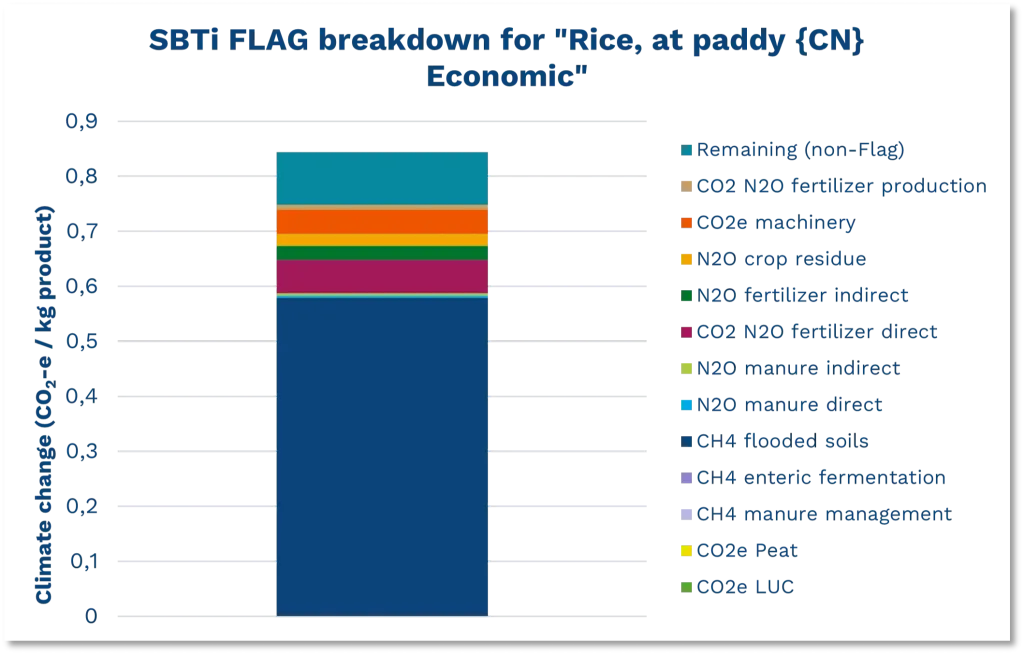
The standout feature of this update is that Agri-footprint 7.0 FLAG splits the total environmental impact of a product into multiple impact categories as defined by the SBTi FLAG guidance.

Compared to our previous Agri-footprint FLAG version, this update features more detailed FLAG impact category breakdowns. Beyond providing granular hotspot insight, these breakdowns align with SBTi's specific reduction targets. This helps you to make sure your efforts are correctly steered toward these specific SBTi FLAG targets. An example is the requirement for larger LUC emission reductions compared to Land Management emissions. 

The following data breakdowns across the specific SBTi FLAG categories are available in Agri-footprint 7.0 FLAG:

Land Use Change (LUC) emissions, further categorized into:

  • Deforestation and Forest degradation

  • Conversion or draining of Coastal wetlands

  • Conversion or draining of Peatlands

  • Conversion of Savannas and natural grasslands

Land Management emissions, further categorized into:

  • CO2

  • CH4

  • N2O emissions

Methodology: Linear Discounting for LUC Impact

One of the methodological changes is the way emissions due LUC, including deforestation, are calculated. The SBTi FLAG Guidance requires the application of linear discounting over the last 20 years.

  • This approach considers more recent LUC events to have a higher impact than older ones, reflecting the urgency of recent land use changes.

  • This replaces the previous equal discounting approach, which spread the impact of LUC emissions evenly across the 20-year period.

The detailed data split enables you to get detailed insights and target specific sustainability improvements across your supply chain, allowing you to determine where the most progress in sustainability can be made.

The Agri-footprint 7.0 FLAG database supports you with FLAG-aligned reporting in a faster and easier way. It's methodology is aligned with the SBTi FLAG guidance and provides a granular breakdown of emissions. Instead of manually calculating for instance the complex and detailed LUC emissions, the database delivers you a direct, aligned output for this specific impact category. 

Trusted environmental data for sustainability reporting and target-setting

Publicly available methodology

Just like other Agri-footprint data products, the FLAG version is a source of consistent, high-quality environmental data recognized and trusted by industry leaders worldwide for their sustainability reporting and target-setting processes.

If you are interested in learning more about the specific methodology used in the updated Agri-footprint FLAG database download the full methodology documents.

How to access Agri-footprint 7.0 FLAG?

License options

Whether you're a large multinational corporation or a specialized industry player, our various license models ensure you can access the essential SBTi-aligned data you need.

Commercial, Consultancy, Developer, and Enterprise license are available for Agri-footprint 7.0 FLAG. 

To discuss the licensing options and find the best solution for your data requirements, please contact our team.

More about SBTi and SBTi FLAG

The Science Based Target Initiative is a global collaboration among non-governmental organizations established to assist companies in setting greenhouse gas (GHG) emission reduction targets consistent with the Paris Agreement objective of limiting global warming to 1.5 °C. This initiative provides a methodological framework that delivers sector-specific guidance for quantifying and reporting GHG emissions, as well as aligning these emissions with corresponding reduction pathways. One of the sectors addressed is Forest, Land and Agriculture (FLAG).

More information

Get in touch

Jixin Liu - Sales Consultant, Blonk
Jixin Liu
Sales and Customer Support Consultant

Do you have questions about Agri-footprint FLAG, or are you interested in a license? Get in touch with Jixin.