
20 Apr 2026

Bridging the data gap in food system sustainability

One of the main goals of the EFF database is to ensure consistency and transparency in environmental footprinting within the food sector. Traditionally, sustainability professionals have often relied on fragmented data sources with varying methodologies, making it difficult to compare the sustainability of different food products or to set reliable benchmarks.

The EFF database addresses these challenges by providing a harmonized PEF-wise footprint database for a wide range of food products commonly consumed in Europe, aligned with the Product Environmental Footprint (PEF) method recommended by the European Commission.

Environmental Footprint of Food Database at a glance

The EFF database offers a comprehensive look at the environmental impact of food in Europe.

Scope

272 food products, modelled from cradle-to-grave, including supermarket and consumption stages.

Geographical coverage

Products in scope are modelled for 27 member states of the European Union, a European average is also included.

PEF-wise methodology

The database has been developed in line with the EU Product Environmental Footprint (PEF) framework.

Multiple impact categories

Environmental impact is assessed across 16 categories from the EF3.1 impact assessment method.

Standardized classification

All products are categorized using FoodEx2 codes, ensuring easy integration with existing EFSA food consumption data.

Critically reviewed

The database has been externally reviewed by LCA experts from RIVM to ensure data quality and methodological robustness.

Open access

The EFF database* and technical documentation are publicly available to facilitate future updates and robust application by end users.

* the underlying LCIs used in the creation of the EFF database are currently not publicly available.
If you are interested in utilizing these datasets or exploring collaboration opportunities, please contact us directly. 

Database scope: from consumption patterns to product selection

To ensure the database reflects what Europeans actually eat, the scoping process began with the EFSA Comprehensive European Food Consumption Database. By aggregating surveys conducted after 2009, our team identified products representative of average EU dietary patterns of adults.

The selection followed a rigorous hierarchical approach using the FoodEx2 system:

  • Hierarchy Level 4 served as the starting point, as it is the first level specific enough to define ingredients.

  • A 1% cut-off criterion was applied to ensure only relevant products are included; only products accounting for more than 1% of consumption within their group were selected.

  • For complex categories, Level 5 products were selected to ensure at least 80% coverage of that category's consumption.


FoodEx2
is a comprehensive standardized system developed by EFSA for the detailed classification and description of food items. It uses a hierarchical coding structure and descriptive facets to ensure consistent data collection across various domains, such as food consumption.

Methodology: a harmonized modeling framework

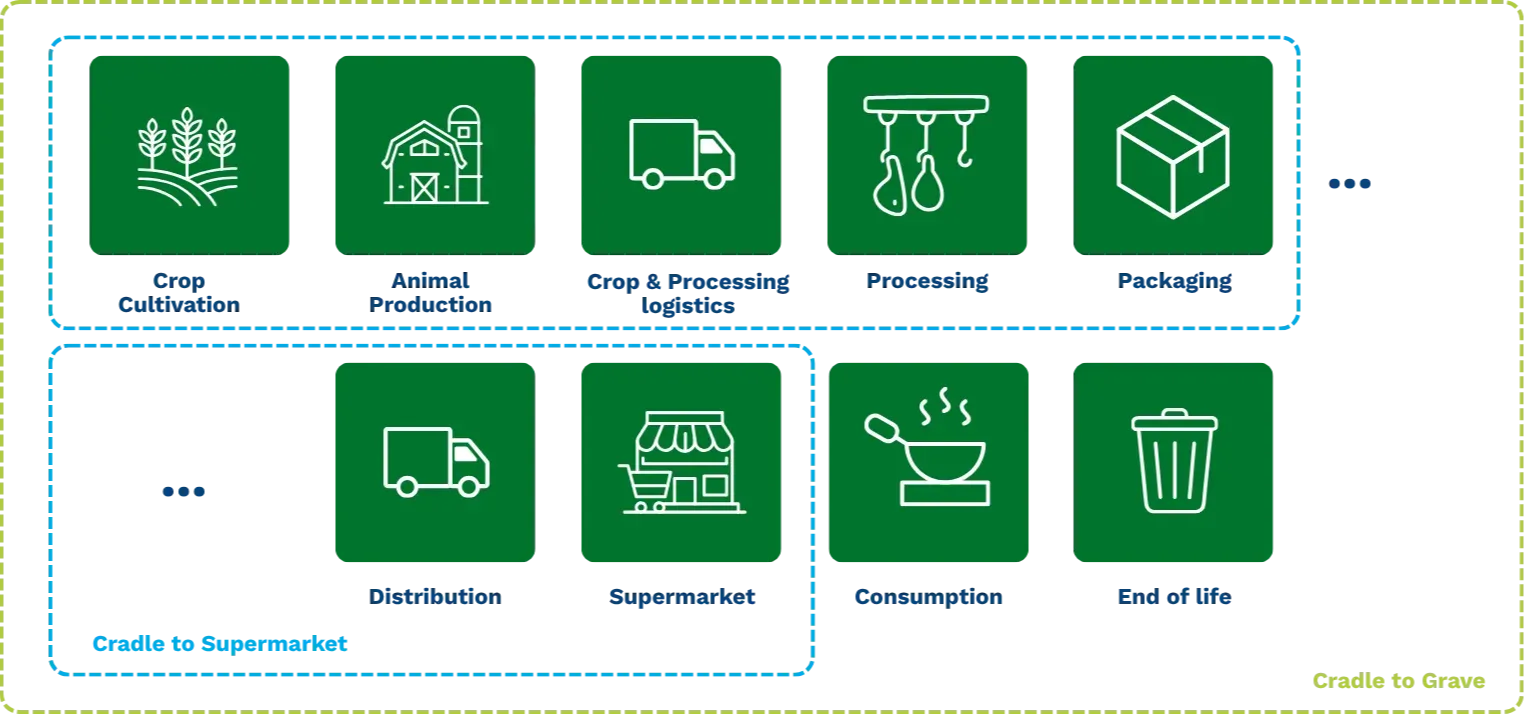
The EFF database provides results for two distinct system boundaries: cradle-to-supermarket and cradle-to-grave. This dual approach allows for fair comparisons between raw and pre-cooked items while acknowledging that consumer behavior heavily influences the final "grave" stages. For example, the impact between coffee and coffee beans is significantly different due to dilution, and rice is expanded in weight due to absorption of water while cooking.

Modeling principles include:

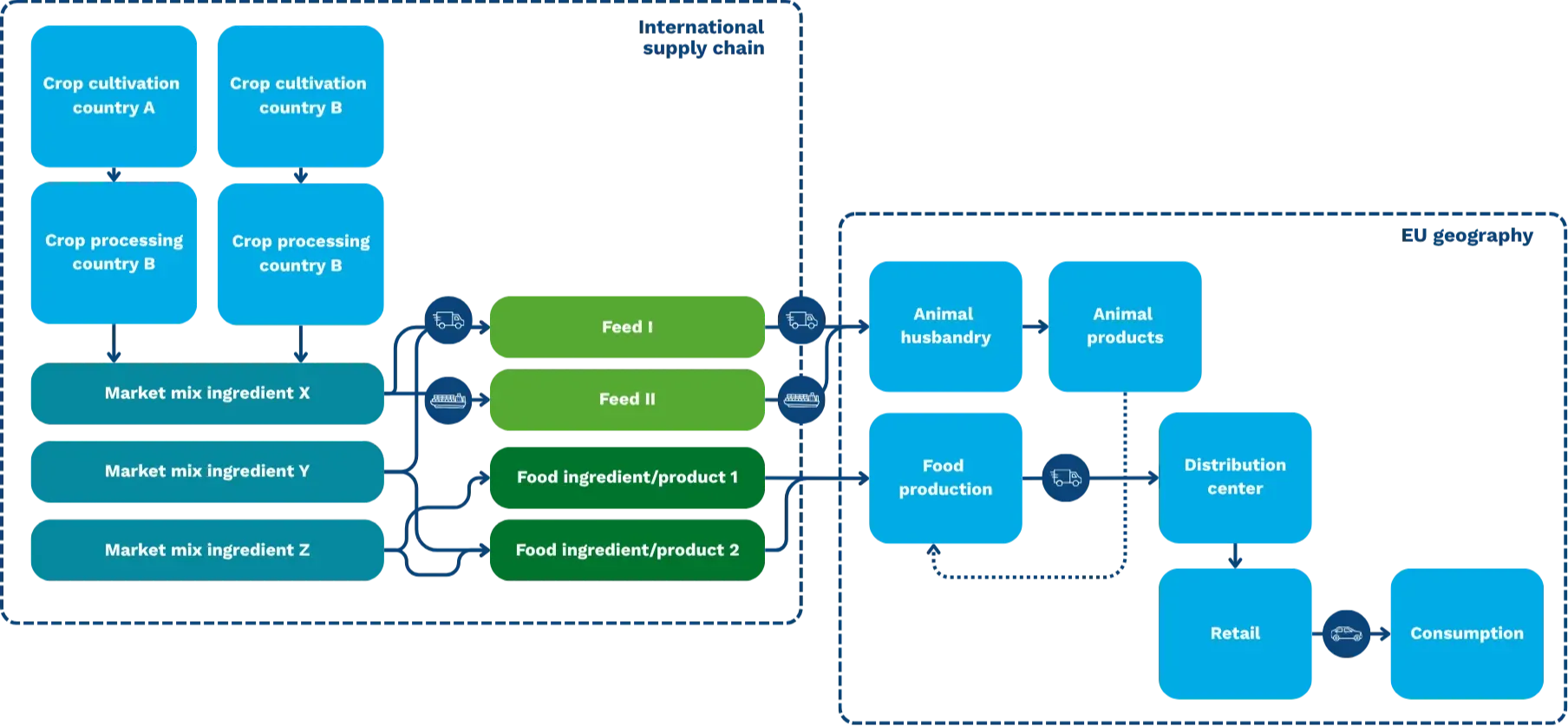
  • Life cycle stages: the system tracks impacts from crop cultivation and animal production through processing, packaging, distribution, and final consumer preparation.

  • Allocation rules: to ensure PEF compliance, the database primarily uses economic allocation (e.g., between meat and co-products at a slaughterhouse). Unless the PEFCRs prescribe another allocation type, like biophysical allocation for specific sectors like dairy production systems. 

  • Emission modeling: environmental impact as result of emissions, consistently calculated for various life cycle stages, based on specific product PEFCRs or PEF guidance reports. For example: direct and indirect laughing gas emissions are calculated using IPCC (2019) calculation rules for all modelled cultivations.

  • The Circular Footprint Formula (CFF): This is the specific PEF way of modelling packaging materials. The CFF is used to accurately model the recycled content and end-of-life (recycling, incineration, or landfill) of packaging materials.

Data selection and the challenge of public access

A unique challenge of the EFF database was the requirement for license-free distribution. To achieve this, the project utilized a strategic hierarchy of data sources:

  • Activity data: extracted from international statistics like FAOstat and Eurostat to build specific Life Cycle Inventories (LCIs).

  • LCI background data: built using publicly available datasets from ELCD and Agri-footprint.

  • Market mixes: the geographical spread of global supply chains was captured by assessing the specific market mix of ingredients for each of the 27 EU countries, using 5-year trade and production averages.

Data generation at scale

Data Generation Pipeline

Developing a database of this size, covering 58.500 unique Life Cycle Inventories (LCIs), requires more than just traditional manual LCA modelling. To handle this complexity, our data team utilized our Data Generation Pipeline (DGP) to enable a systematic, scalable approach to data management and processing.

By using the DGP, we move beyond simple data collection to systematic workflows that ensure:

  • Methodological alignment: we use “Life Cycle Engines” to guarantee that modelling rules are applied consistently across all system boundaries.

  • Reproducibility: every dataset is built through versioned workflows, creating a transparent and auditable trail from source data to final result.

  • Updatability: because the source data is versioned, updates can be implemented consistently across the entire database, ensuring the data does not suffer from methodological drift.

Data as an enabler for sustainable food systems

The EFF database represents a significant step forward in a collective effort to build a more sustainable food system. By providing the data needed for informed decision-making, it empowers sustainability professionals and policymakers to conduct more accurate assessments, to drive meaningful change, and to support the development of evidence-based solutions for more sustainable food systems.

Access the EFF database

The European Environmental Footprint of Food database is publicly available via Zenodo, CERN’s open research repository. Also, the full technical guidance documentation can be downloaded directly from the platform. 

Moving forward: from EFF to the Minerva LCI Database

Looking ahead, we are committed to the continuous evolution of our background data through the Minerva LCI database, the follow-up database to the EFF database. As the core of our LCI expertise, the Minerva database provides PEF-aligned and geographically representative datasets that offer extensive opportunities for further development. 

We are currently transitioning from a static repository toward a dynamic research framework, already delivering the Minerva LCI Database to leading research institutes. By prioritizing methodological innovation and thought leadership, we are defining the next generation of LCA development. 

Stay informed: Read more about our vision for long-term LCA database development in our upcoming article.

Get in touch with our experts 

Bart Durlinger, Director- Digital Solutions, Blonk
Bart Durlinger
Director Digital Solutions

Do you have questions about the EFF database? Or are you interested in how our Data Generation Pipeline can support you with the development of high-quality, large-scale LCA databases for your organization? Get in touch with Bart Durlinger.